



- SERVICES
- Data visualization
Data visualization
Insight into your organization
Every day, your organization collects vast amounts of information. Valuable data is available from legacy systems, data warehouses, and other applications. But how do you connect all that data in a smart way so you can make the right decisions based on all these insights? It all comes down to a robust business strategy and business optimization.
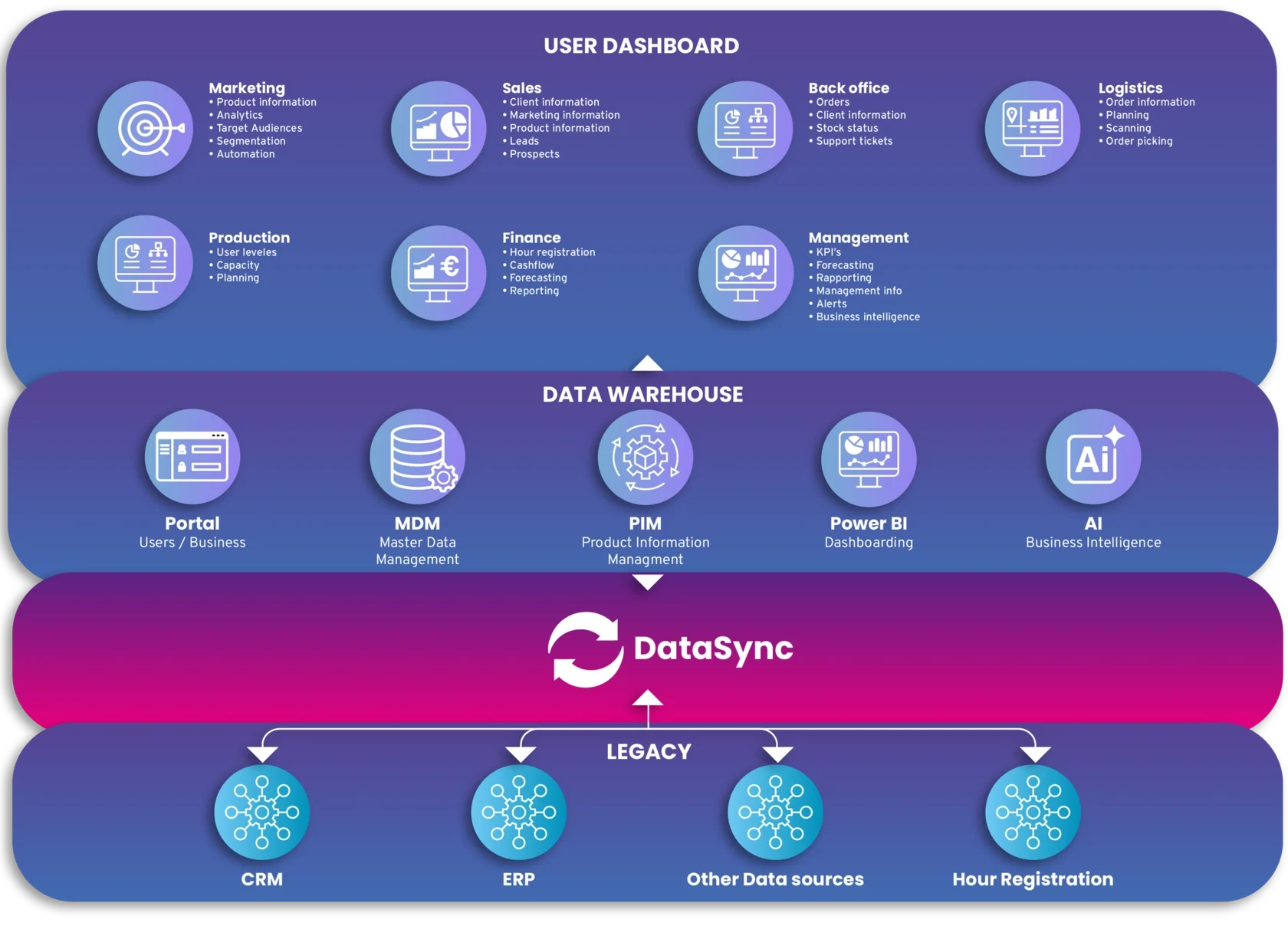
In our experience, acting on information is often a far greater challenge than collecting it. With our business intelligence tools and business intelligence consultancy, we present your management information in a clear dashboard. We reduce complex data to its absolute core, leaving only what truly matters. We connect all your live data sources, from webshop and POS systems to inventory, ERP, and CRM systems. This way, all your business information is integrated into a centralized system. So you can respond quickly, based on up-to-date business and market insights.
Data Visualization

SIENN’s approach to unlocking and visualizing your data
At SIENN, we understand how important data centralization and visualization are for your organization. We handle the data within your organization with care. That’s why we follow a thorough approach.
We always start by mapping all existing data sources and processes. Next, we work with you to create an integrated data environment in which all data is stored and can be presented intelligently. We ensure that the data integration process is handled efficiently, allowing your employees to continue their daily activities during and after the integration. This way, your business operations remain uninterrupted.
Step 1 | Collecting all data
The very first step in our approach to data centralization is identifying and collecting all data sources within your organization. The scope or origin does not matter. These data sources may range from operational data, customer data, and financial data to external data sources. Think, for example, of your CRM or ERP system, or other relevant data sources.
Step 2 | Bringing all data together
We synchronize your data across on-premises storage, cloud storage, and different cloud storage providers. First, we configure the source and target storage locations. Then, a synchronization agent is installed at the source location. This agent acts as the interface between the source and target storage. Next, the synchronization process begins, taking into account the synchronization direction, any filters for file types or paths, and the synchronization schedule. At SIENN, we often work with DataSync, a software solution that simplifies the process of synchronizing data between different sources.
Step 3 | Storing your data in data warehouses
After synchronizing your data with DataSync, we store it in a data warehouse. It is essential that the new system integrates seamlessly with the existing systems within your organization. This ensures that the data integration process runs smoothly. For example, we standardize data formats and use APIs and middleware to enable standardized communication. We also create a detailed data migration plan. The synchronized data is made available in the data warehouse, whether in a cloud storage service or on-premises storage. We then extract the data from the data warehouse for further processing. After transformation, the data is loaded into the data warehouse using ETL: Extraction, Transformation, and Loading. In this phase, the data is structured in a suitable format for analysis.
Step 4 | A dashboard for every department
With dashboarding, you can present and communicate data in a structured, clear, and visual way. Dashboards provide immediate insight into your organization’s performance through business intelligence dashboards. This allows you to easily identify trends, patterns, and exceptions without conducting in-depth analyses or searching through multiple reports. By applying filters, you can quickly access specific information across different departments. Data is displayed in real time, supporting your strategic planning and focused communication across the business. Think of a business intelligence dashboard, marketing dashboard, project management dashboard, HR dashboard, or supply chain dashboard. You gain insight into key financial KPIs such as revenue, profit, and cash flow, enabling you to adjust your business plans accordingly.
Targeted communication and strategic planning
With data dashboarding, you can present and communicate data in a structured and visual way. This supports strategic planning and targeted communication across the business. Think, for example, of a business performance dashboard, marketing dashboard, project management dashboard, human resources dashboard, or supply chain dashboard.
- Are you operating in the financial sector? Then you gain immediate insight into key financial KPIs such as revenue, profit, and cash flow. Based on these insights, you can adjust your business plans accordingly.
- In a marketing dashboard, you can track click-through rates, conversion rates, and return on investment. This helps marketers within your organization optimize campaigns and allocate budgets effectively.
- In a project management dashboard, you can monitor project progress, including milestones, task completion, and resource management. This enables project teams to focus on key tasks and make timely adjustments to achieve project goals.
- Using a sales dashboard to monitor performance? It displays KPIs such as daily revenue, conversion rates, average transaction value, and abandoned shopping carts.
- A KPI dashboard provides insight into performance, real-time data, more efficient decision-making, targeted focus, transparency and accountability, increased customer focus, continuous improvement, and data-driven decision-making.
- For production teams, dashboards can display operational metrics such as production output, equipment efficiency, inventory levels, and quality measurements.
- In accounting, management, and logistics, dashboards provide insight into expenses, budgets, employee performance, inventory levels, supplier performance, and operational efficiency.
Executing a data migration can be a complex task
With data migration, you transfer your company’s data from one system to another. In most cases, the goal is an upgrade, consolidation, or change of the technological platform or system you currently use. Transferring large amounts of data in a secure and reliable way can be a complex and challenging project.
For example, when moving to a cloud-based platform or migrating legacy systems to modern solutions, you may also transition to new systems or a different business application. The volume of data, especially in large datasets, can slow down the migration process and impact system availability. That is why efficient management and sufficient resources are essential. The challenge is to minimize downtime through careful planning. We ensure your data migration is successful through thorough planning, execution, and validation.
Ten benefits of unlocking data
Data accessibility is essential if you want to leverage the data within your organization to improve business performance.
1. Better decision-making
You gain access to comprehensive and up-to-date data, enabling you to make more informed decisions.
3. Competitive advantage
With real-time insights, you can respond more quickly to market trends and competition.
5. Effective reporting and analysis
You can perform in-depth analyses and generate reports to measure performance and achieve strategic objectives.
7. Greater innovation
You gain a foundation for developing new applications and driving data-driven innovation within your organization.
9. Better regulatory compliance
When data is properly managed and governed, it becomes easier to comply with laws and regulations.
2. Increased efficiency
You can reduce duplicate work and time-consuming manual processes by automatically integrating data.
4. Increased customer focus
Unlocking your customer data enables personalized customer service and targeted marketing.
6. Improved data quality
Data accessibility supports processes for improving data quality and consistency.
8. Cost savings
More efficient data processing and better decision-making can lead to lower costs across the business.
10. Improved collaboration
By combining data and making it accessible to different teams, collaboration within and across teams improves.
Need clear insight into your data? Let SIENN support you.
Are you running into obstacles when it comes to unlocking your data? Or are you unsure where to start? Do you lack the right tools or expertise in-house? We can help. SIENN specializes in data accessibility. We help you quickly and efficiently collect, integrate, and transform all relevant data within your organization into actionable information. This enables you to make better decisions, work more efficiently, and achieve your goals based on accurate and relevant insights.

What can we do for you?
Get in touch with us to explore opportunities or request an intake.